So we are coding…

After a super successful Hour of Code last fall, I have been tasked (along with my courageous Middle School Head) to create a 7/8 elective in Coding/Computer Science/Etc. I resisted for a long time with questions such as:

  • “Are we just jumping on the hit parade band wagon?”
  • “Do our middle schoolers really need this?”
  • “What has to give from their other courses for kids to take this class?”
  • “Why would I, a person with music ed, ed leadership, and curriculum integration skills, be the right person to teach a course in coding?”
  • “How do we differentiate a class that is appealing for our advanced coders (like our amazing app writer) as well as to our kids who think it would be cool to try something new but have no experience?”

So we answered them:

  • Maybe, but this is about thinking skills, so we are cool with it either way.
  • Yes, this is their time to taste lots of disciplines and so a this amuse bouche of coding comes at the perfect time.
  • Nothing, we with our new six day schedule this will be an additional choice in the visual art rotation.
  • It is about project management, thinking skills, and facilitation more than actual content knowledge of coding, so yup, I’m going to be ok. (This answer took the most convincing and cajoling by my MSH and Dir of C&I.)
  • We work collaboratively, providing both leadership and independent work opportunities for our advanced kids. We create differentiated experiences where the outcome is more about thinking skill and process, rather than product.

Now comes the tough work, design the course. Where to start? Information gathering!! I’ve looked at countless approaches to how to teach “kids to code”. We have all the iPad apps. We have an account with idTECH365. We’ve played with code.org. We’ve purchased some Raspberry Pi devices. I’ve played Code Combat, Minecraft, and Scratch. We’ve downloaded STEM and CS standards from the state and national level. I’ve  saved #kidscancode to our hootsuite feed.


thinktwicecodeonce

At this point, we need to sit in a room and ask some more questions:

  • What is important? (For me it is thinking skills over language.)
  • What are our major objectives? (I’m thinking we have three major units surrounding EQ’s.)
  • What are our resources?
  • What is our timeline?

We will have many more questions to answer this week as we buckle down and hash out a curriculum. We also know that curriculum is a living thing and that it will grow and change with our students. We know there are many crossroads on the coding path and we’ll choose what is best for our kids and gives them the most out of their experience. More than anything, I want them to be empowered to learn and try new things. For our advanced kids that might mean exploring a part of coding they haven’t tried before or using their skills to teach others and for our newbies it might mean having them try something out of their comfort zone.

keep calm and code

I’m trying to practice what I preach in terms of teaching and learning right now; stepping out of my area of comfort and working to design an innovative, creative, and engaging course. Allowing for the students to be the leaders (with measured facilitation of course) and for them to take hold of their own learning process. This is an exciting adventure, time to jump in!



#dcmooc-goals

20140518-062826-23306083.jpg

I came across a new MOOC that appealed to my sense of neediness. Alec Couros, in conjunction with the Dept. Of Education for Saskatchewan, is leading a multi-week course on Digital Citizenship for educators. The course overview sounded like a great medium to dive into conversation with others about living and teaching in a digital world. I’m also interested on how this is presenting in a large scale, government funded (yea Canada!) to a wide swath of teachers. How is the pedagogy learner-centered and is that even possible in a MOOC?

This week we are charged with defining our goals for the course. As stated above, I want to continue my participation in the conversation of teaching and learning in the digital age but also, I’m as a professional development leader-I’m interested in the balcony view of the course presentation and delivery. I will jump back and forth between the learning pool and the balcony as the course goes on. (If these terms seem ridiculous, check out Leadership On the Line.) I will achieve these goals by being an active learner-joining in on the synchronous sessions (when possible, they are in MT time), maintaining a presence on twitter and google+, and by reaching out in our asynchronous time.

Here’s to another learning adventure online!! #dcmooc

edubragging

A few weeks ago I had the opportunity to brag on behalf of the neat work coming out of several of our classrooms. I am so proud of these teachers who are trailblazers for integrating tech into their classrooms. It was really nice to celebrate their work and now I share it with you!


How do you celebrate the success of YOUR superstars?

#educhristmas

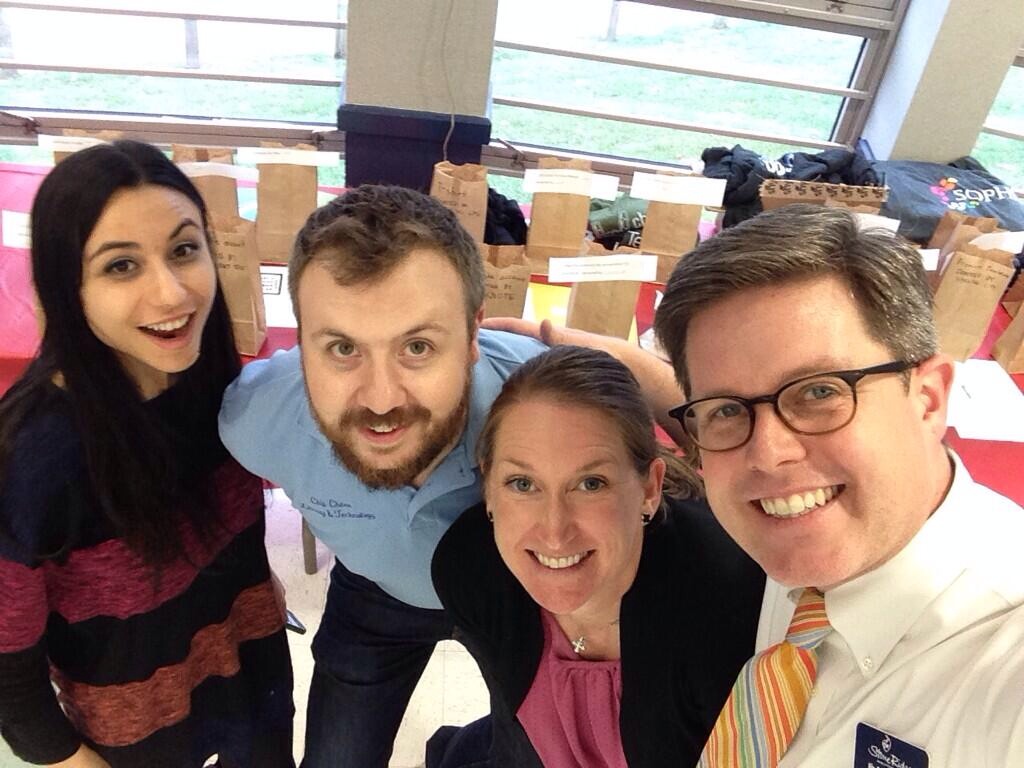
edcamp MetroDC has come and gone and I have that amazing feeling of happy exhaustion that comes from months of planning coming to fruition. As an edcamp organizer, I feel like this is one of my babies. As we plan, we draw together on the strengths and resources of our local and national PLN networks. We use lots of collaborative tools. We ask for a LOT of free stuff. We make pleas on our networks and within our faculty to build a registrant list. We use a lot of tape, sticky notes, bandwidth, and coffee. 

Image

And then the day arrives. And it is like #educhristmas. I have never been to an edcamp that doesn’t seemingly fall into place and leave its participants inspired and excited about their educational practice. I have seen twitter friends meet in person, old friends cling to their annual day together, veterans teaching newbies, and ideas new and old swirl in the ether. It is my favorite edu-day.

This year was no exception. Our team worked for many months to pull our program together with hopes of leaving no detail aside. We each naturally took a role in leadership that highlighted our own strengths. (And as for me, challenging my fear of asking people/businesses for things, and GETTING them!) It was a fairly pain-free collaboration; to come together and put an event out there for educators to learn–what an honor! I had the pleasure of sharing edcamp with many of my Norwood colleagues, which was a great blessing! To see their enjoyment of edcamp was a gift to me. I also took advantage of my own learning time, particularly enjoying sessions on coding and mindfulness. And, as always, my edutriplets and I were able to share our knowledge and love of Twitter with the newbies in the room.

Image

I’m sure my list of “edu-favorites” will continue to grow in the afterglow of edcamp, but here are a few highlights from the day:

15 Minute Filmmaking Session-This is edcamp

Mindfulness in Education

Smackdown (where @mrfichter brought me to tears with the NPR Women in Tech resources #nprwit)

And some great reflections from friends:

Maris 

Margo

Matt

Vicki

And so a brief hiatus from edcamp planning begins until we start fresh for 2015. In the meantime, edcamp Philly is in May and edcamp Baltimore will be in the fall. edcamps happen all over the world, every weekend and every one feels like #educhristmas.

Image


The why before the how

I’ve spent a lot of time in the last two and a half years as a tech integrator asking questions. I usually start with, “what are your goals or objectives?” “What do you want your kids to know or be able to do, regardless of tech.” From there, a process of choosing the right tool, pace, and content for the project comes naturally.

When we start any conversation in ed tech with an app or a device, we are cutting short the conversation. We aren’t allowing learning to drive our choices but rather the tool. Unless we are speaking in the terms of CS or STEM, most technology is being used to enrich and enhance a learning process or product. (At least in the S and A stages of SAMR.)

As our ed tech revolution drives through our schools at an unprecedented pace, we simply must continually return to the why and what of our teaching. This will provide a pedagogically solid foundation of teaching and learning rather than surface level application of a cool tool.

My education hero, Lucy Gray provides an excellent op-ed in edsurge and I encourage you to check it out!

Shall we continue this conversation? Tweet me or comment below.

20140328-131703.jpg

edcamp evangelist!

Image


T-minus 12 Days until our 2nd Annual edcamp MetroDC hits the ground running. The last few months have been a whirlwind of planning, tweeting, sponsor-wrangling, and google hangout-ing. I have had a blast getting to know my planning teammates and am tremendously excited for our edcamp. 

I love edcamp with a passion. I first attended edcamp Philly in the spring of 2009 and have attended edcamps all over the country, met colleagues new and old, built great friendships, and most importantly, learned so much! My participation in edcamp has led me to believe that the professionals in the room have innate value and knowledge. I believe that the best professional development comes when practicing teachers share their ideas and connect to one another. I believe that amazing professional development does not have to come in the form of an expensive conference or keynote (though these are nice, of course.) 

When edcampers gather and conversations start to flow, my heart rate increases. When people learn about the power of twitter for professional practice for the first time, my heart simply jumps with fluttering. When we have a smack down, it is amazing my heart doesn’t attack! edcamp has truly stolen my professional heart and I’m an evangelist!

Have you edcamp-ed yet? Do you live in the DC Metro area? Do you love to learn? Do you like free stuff? Did you know that edcamp MetroDC is happening on April 5 at Stone Ridge? Have you registered? Do Not Delay! Check us out and join us, we can’t wait to learn with you.


What Equals Success?

So here we go again, another formula for success. This time in the package of three factors-a feeling of superiority, insecurity, and impulse control. Oh, and if you happen to be part of a specific cultural or ethnic group, that helps too. In the newest book from Tiger Mom, Amy Chua and her husband, Jed Rubenfeld, we have an exploration of these three topics and how they equate to success in America.

From the Front Cover of U.S. Hardcover Edition Penguin Press February 2014

**Full Disclosure: I have not completed this book yet. I attended their lecture last night at Politics and Prose in DC and have read  their op-ed in the NY Times as well as several critiques including this one and this one, oh and this one, too. I am not in any way trying to negate their data or be critical of its validity. What follows is my thoughts on the word, success.**

My initial concern is that, according to Chua and Rubenfeld, success seems to be defined only through the lens of academic and financial success. As an educator of all kids, I simply can’t define one’s life success solely through the lens of financial or career gain. As an educator, whose lifetime net worth is far from top tier, am I determined to be unsuccessful despite anecdotal and transcriptional evidence to the contrary? What about the great artists and musicians of our time who perhaps struggle financially but create or perform great works of art? What about our most successful Olympic athletes who achieve world championship success yet work at Home Depot to afford the bills. What about a man from Georgia, who became a preacher, who would change the world? What about families who sell everything, move to a foreign country, and work to make a difference in world poverty? Are these people not successful in their own right?!

(A colleague remarked to me today, “what about being happy?”, to which I replied, what if that is a cultural value, not a human one? But that, I think, is a whole new blog post, to come after I digest The Triple Package.)

From the perspective of a teacher, I want my kids to know that success comes in more ways than money. Yes, financial security is vitally important. However, some of the richest people in the world count their success in many different ways. I want them to know that hard work is important, as is impulse control, humility, physical and spiritual health, play, joy, and resilience. There is no magic button to success–but there are many roads.

I don’t think I’m yet finished on this topic…do you? Let’s start a conversation: @teach2connect

For a bit of humor…in case you missed this gem from 1987, here is a hoot of a look at rising from the bottom of the food chain to the top.

Oh and for a musical interlude, from How to Succeed in Business Without Really Trying, 2011

Joys and Perils Part 3

Today I had the distinct honor to speak to the Parent’s Association of my amazing school. I was so pleased with the turn-out of parents and their thoughtful, engaging, challenging, and gracious participation in our discussion. I am such a believer in the village approach to raising “our” children. I cannot imagine doing my work alone and the work of parents is exponentially more difficult. I tip my hat to our outstanding parents and the hard work that they do, particularly in our competitive, rapidly changing age and location. In the words of one of our parents today, “Be Strong.”

rethinking tech and assessment

I think if I were to write my philosophy of education in one word it would be “rethink.” I love the power of looking at how we have done things and rethinking how we can make them different and/or better for today’s learners. As part of my work this year, we (a cross divisional working group) are examining the role that technology can play in raising the bar on assessment. We are using Bloom’s Taxonomy and the SAMR model as our benchmarks in this process. This graphic from the great Kathy Schrock, is a spectacular guide for us.

samrblooms

Our current task is identifying places where we are already moving up the continuum of SAMR. From there, we will explore new places as possibilities to move to re-definition. Along side this process, we are looking at the scope and sequence for technology instruction based on the ISTE standards.

Our current sticky wickets:

  • As a school without “tech class”, upon whose shoulders does it fall to teach some of the basic computer operations in order to complete projects using tech? (If you don’t know how to type, how do you create a text-based presentation?) (If you aren’t sure the difference between left click and right click, how do you record a podcast?)
  • What are the philosophical and pedagogical implications for moving towards more integrated technology in the classroom?

There are so many more questions than answers at this point and that is tremendously exciting. There is great potential at hand. I am grateful to the working group for the opportunity to grapple with these ideas.

Teaching the Teacher

I just spent two days in training for an athletic related certification. I spent Saturday and Sunday sitting in a conference room for two nine hour days. I learned some new information about planning training for my runners. I was affirmed in my beliefs about interval work, mental training, and injuries. Many good things came out of these two days.

But alas, it is difficult as a teacher of teachers to be in a room for two days, sitting for almost 9 hours each day, and not have some critique about delivery. Quality professional development does not simply consist regurgitating facts with anecdotes; or at least, it should not be. It should be about providing a learning experience that allows participants not only to take in information but also process it.  Care must be given to adult learning theory, advances in digital communication, and frankly, the human body’s capacity to remain sedentary for 8-9 hours.

Here I was, at a training for coaches of running….where we were not actively practicing movement. It was disturbing. We were seated in rows with our workbooks consisting of hundreds of slides and this was supposed to turn us into qualified coaches. It was unclear who was in the room, other than the professional triathlete and coach upon whom the head instructor picked for two days. Who were we, why were we there, what has brought us into this space? How could we have used our 18 hours of seat time to build relationships with other coaches and coaches-to-be? How could the training have been appropriately tailored to the group for optimum efficacy?

Well, I’m just playing Monday Morning Quarterback, but here are some ideas:

  1. Engage in a pre-training survey that is shared with the coaching team. Plan seating to build for teams. Provide demographics up front (rather than a show hands) so that people understand who is in the room.
  2. Rather than a cookie cutter approach to the curriculum-use the pre-survey information to target where more/less time should be spent on direct instruction. The manual is great-but work beyond reading the slides and adding personal narrative to convey the information.
  3. Consider front loading or “flipping” some of the instruction and creating self-paced learning modules for some of the more cut and dry content areas and use a forum to provide Q/A. (For example, some of the physiological material, nutrition, and injury material could easily be front loaded as could the history of running/coaching)
  4. Use adult learning theory-have people team up and read material together and present synthesis (with coach guidance, of course). Provide practical application of physical elements like form and injury prevention. Use multi-media approaches to demonstrate topics. Do a demonstration the elements of a training meso-cycle before presenting the expectation of one. (I’m thinking a think aloud.) Go outside and RUN.
  5. Consider separate tracks of courses for those coaching at different levels or at different distances. I used to coach adult marathoners but now I focus almost entirely on middle school and I learned no accommodations for youth. Also, consider a track for coaches who focus on volunteer or program based coaching and those who focus on building a business of group and individual coaching.
  6. Finally, just because someone is a fast runner or a good running coach does not necessarily mean they will be the best program director. Parse out qualities within your coaching facilitators to determine who will best serve your population in terms of emotional intelligence and conveying the organization’s message. (I found 3 out of the 4 instructors to be excellent, given the material and format in particular, but they were not the lead. This was frustrating, disappointing, and at times, offensive.)

Yes, there will be a formal survey. Yes, I feel comfortable sharing this information with the organization. And yes, now I need to study for my 100 question t/f and mc test. (I won’t even touch that subject!!) As an educator, I hope to always be striving to do things better. To always attempt to grow and serve in the best way possible. My criticisms are not meant to condemn, but to critique and help a good organizational framework become great.