
I love the Kid President and in honor of this week’s Thanksgiving celebrations, I share with you, “20 Things We Should Say More Often”
Blessings to you and yours this Holiday season.
I love the Kid President and in honor of this week’s Thanksgiving celebrations, I share with you, “20 Things We Should Say More Often”
Blessings to you and yours this Holiday season.
An oldie but a goodie of an article from The Huffington Post came across my facebook feed this morning. “Are We Raising a Generation of Helpless Kids?” is a short but very honest look at the results of “everyone’s a winner” culture. I find myself more and more being discouraged by the need for independence, resilience, and patience in this generation’s crop of children. However, with the discouraging traits of the Gen Y, Millenials, the iGen or whatever else you want to call them, come a great deal of gifts. Today’s children are open to figuring things out. They are quick to fight for justice (fairness) for their peers. They are not tuned out, but rather very aware of what is going on in the world around them.
So why do we panic? I did a quick search on HuffPo for the words “a generation of”. I retrieved no less than 37 articles including:
Raising a New Generation of Readers
Is Technology Creating a Generation of Bad Decision-Makers?
Is the Media Creating a Generation of Narcissists?
Are We Raising a Generation of Sugar-Addicts?
I could go on and on with links, just from this one mixed-genre media site, but I think you get the point. I think as a society we have a lot of work to do in making sure our children have balanced childhoods-with technology, with food, with exercise, with academics, with mistakes, and with praise. A lot of very hard work indeed for our parents, teachers, caregivers, families, leaders, and communities. So how do we approach this daunting task to prevent what these articles would suggest is a decline in just about everything having to do with this new generation?
I think we approach it in the same way we have successfully approached parenting and teaching for generations-time, patience, modeling, love, and peanut butter sandwiches (or maybe cashew butter on gluten free bread.) My favorite analogy in the main article was the phrase, “velvet bricks.” I can think of so many instances in my life where velvet bricks by teachers, parents, friends, mentors, and life itself taught me so much. It is time for us to become master masons with our velvet bricks. We approach the rapid pace of change in our current culture with a collective push against the clock. We embrace the new and honor the old. We give ourselves permission to fail as the adults.
We do not have to be raising “a generation of” anything-we just have to raise a generation…and we have to do it together.
**Today’s Chapel to the 7th/8th grade at Norwood School for our values of the month of humility and gratitude.**
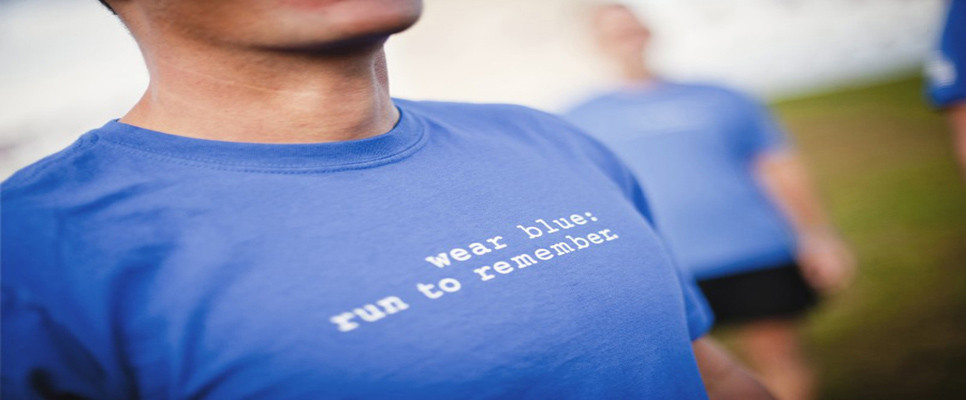
Running can be a solitary sport. It can be a selfish sport. We take mass amounts of time out of our days and away from our families to train. We often race for the sake of racing. We race because we like to-it makes us happy, feel strong, feel accomplished, feel proud. Sometimes we race for charity-I’ve done that a few times. But more often than not, as you hit the starting line of a marathon the vast majority of your participants are in it for themselves. Two weeks ago-I was one of them. I wanted to start, run, and cross the finish line for myself. Not so I could boast-but certainly not in service or honor of others. As I started the marathon two weeks ago-there were charity groups EVERYWHERE. As this was the Marine Corps Marathon-a lot of the groups are dedicated to wounded warriors, veterans groups, and the like. As we started the day-we walked through a gaggle of wheelchair athletes-many without legs or arms or sight. This in and of itself was incredibly humbling…but as we started to run-and I kept seeing blue shirts with THIS logo. They were vibrant and they were constantly around me.
I wasn’t sure what they meant-I figured like many of the other groups-they were a veteran’s memorial group. I remember thinking-that’s nice, I like that logo. I like that font. (such a dork) Then I put it out of my head and continued to run.
I knew that mile 12-14 were going to be terrible. Hains Point, near the Lincoln Memorial, is typically the most boring part of the race. It is flat, breezy, and QUIET. Too quiet.
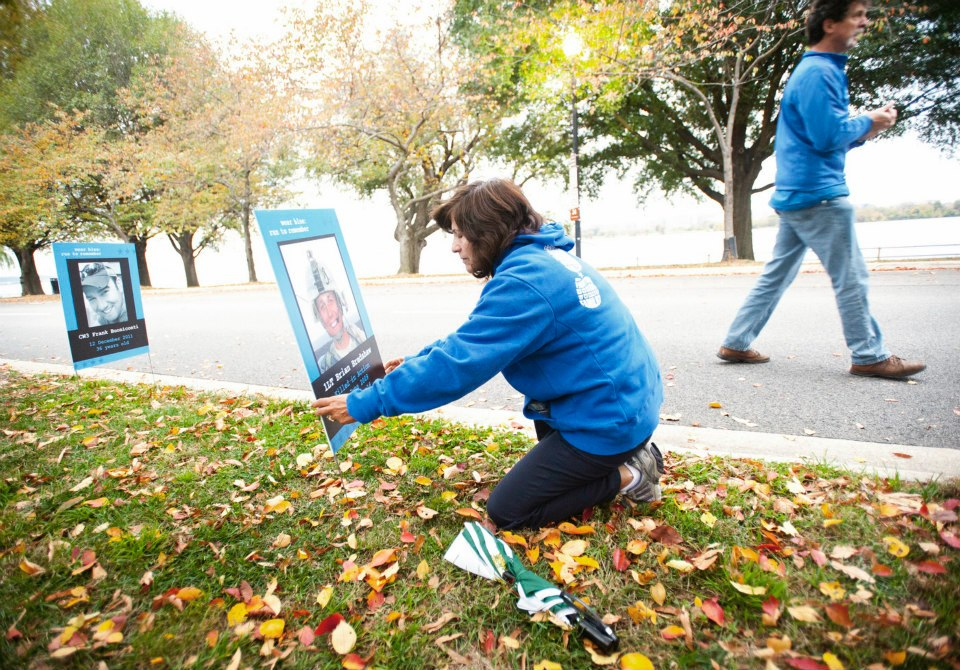
Then I saw this….
A picture. A name. A birth and death date. Lots and lots of them. Faces of YOUNG people. Young people who lost their lives in service to the country. The quiet changed from dreaded to holy. humbling. reverent.
The names kept coming and coming-Ryan, Michael, Juan, Michelle, Jonathan. I started to say them names, with each step or two a new name. Pushing my brain away completely from running and into trying to hold myself together from the emotion of seeing picture after picture.
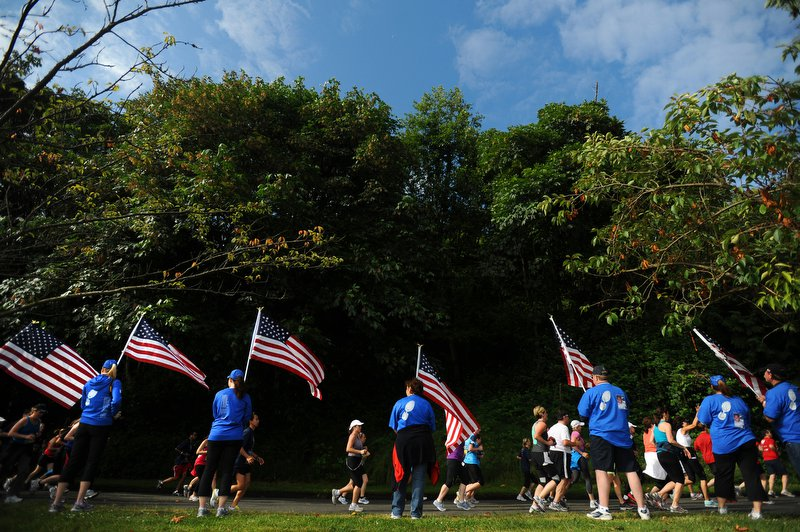
Then the pictures ended and the flags began. The families of the fallen soldiers for half a mile holding large American flags in honor of their loved ones. In loving honor of their lives. In pride for their service. HUMBLED. Small. I felt very small, but not in a self-deprecating way but in a “wow, this world is so big and I am so grateful that these people have done this for me.”
But this is particularly hard for me because I don’t consider myself patriotic. I love my country. I love my freedom. But I don’t consider myself a cheerleader for America. I tend to wish for peaceful solutions to global problems and I don’t really support the idea of using force as a solution. However, I always believe in supporting the people who do make this choice, in service to this country-selflessly. And in this moment-of seeing those who had passed on serving under the guise of the flag-I was most simply grateful.
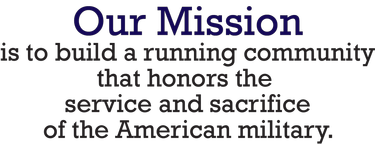
Wear Blue:Run to Remember has a simple mission. Honor the service and sacrifice of American military members. They are a young foundation but they are absolutely meeting their goal of serving as a Living Memorial. I’ve been walking past the memorials in DC for 35 years and this was the first time I have felt a sense of humility, gratefulness, and emotional connection to a memorial. Perhaps it is because these faces are my age or younger. Perhaps it is because these wars are present-in my lifetime. It doesn’t matter to me, either way-I’m thankful.
“True humility is not thinking less of yourself; it is thinking of yourself less.”
― C.S. Lewis, Mere Christianity
It is ok to be proud of oneself. It is ok to accomplish things for yourself. We don’t have to put ourselves down to lift others up. But perhaps, now and again, we can lift them up before ourselves.
“Piglet noticed that even though he had a Very Small Heart, it could hold a rather large amount of Gratitude.”
— A.A. Milne (Winnie-the-Pooh)
On that day, for that mile, and now days later, I feel a great sense of gratitude. I think a bit like Piglet-even as a small person in a big world-I can have a LOT of that.
This weekend, I will have the honor of speaking to parents at my church, St. John’s Episcopal Church-Norwood Parish, about the Joys and Perils of a Digital Life-Parent Edition. In the past few weeks, I have immersed myself in this topic even more than usual by through reading (including the newly released “The Big Disconnect”) and (as fate would have it) listening to the great NPR series on this topic.
The more I read and the more I hear, the more I come to believe that intentional, communicative, compassionate parenting (and educating) is the key for our children. They need positive models, words, support, and follow-through as they, along with us, navigate the rocky waters of a life online.
With my new role being K-8, I feel a bit like the White Rabbit in Alice in Wonderland in terms of time but I have just enough time to share a few quick links of what I’m reading lately (or watching or learning…)

Howard Gardner-Multiple Intelligences are not learning styles, The Washington Post
Do Bedtimes Benefit Children?, The Philadelphia Inquirier
Overscheduled Children-How Big a Problem, The New York Times
Failure of Promoting Failure by Mark Crotty, To Keep Things Whole and What Failure Means These Days by Josie Holford, The Compass Point
Your Digital Footprint-Common Sense Media
Video Games and Learning MOOC by Coursera
Talking Back to Facebook, James Steyer
This week I have the distinct pleasure of sharing the stage with Marti Weston and Shannon Montague at Bryn Mawr School, Baltimore to present on learning, living, and parenting in the digital age. I will specifically working with 6th grade girls and their advisors on the Joys and Perils of a Digital Life. Here is a snapshot of our work to come:
Tomorrow is the first day of my 12th year as an educator. I am so excited to have our halls filled with little people (and not-so-little as the Middle School case may be.) I enjoyed our time last week as teachers returned for meetings and preparations; it was a blessing to renew friendships and start to build ideas for our new year. However, the school is not the school without the children. The children are our purpose. They are the reason we became educators and they complete us.
Last year, I had a theme for the year-Passionate Patience. It was my mantra as I worked with teachers, students, and parents. I worked to strengthen my skill of patience and respect for other’s learning process with a passionate energy. I feel like this was a successful endeavor. So as I geared up for this new school year, I meandered on finding a word that would be a solid theme. I found it in the word Courage. As I move into year three at my school, I believe it is time to start pushing the envelope ever so slightly in terms of moving curriculum and instruction to an innovative direction. For me, it will mean courage to speak respectfully towards rethinking the why and how of our work. As I share the theme with my colleagues, I hope it will encourage them to take risks with the knowledge that I’ll provide a safe place to land. (Just as we do for our students every day.)
I often become nostalgic as the first day of school approaches. I remember my first day of school in first grade, ninth grade, and undergraduate school down to the clothes I was wearing. I’m not sure why these three grades stuck out to me, but perhaps it is because they represent new beginnings, particularly in ninth and college. In school, we have this great gift of summer to relax, renew, and wipe fresh the mistakes of the year before and courageously embrace the year to come. I see this as a grand opportunity, to try new things, to build new relationships, and to boldly encourage our students (and faculty) in exciting ways.
So I think back to Sarah, age 6, headed to first grade with her pigtails and Cabbage Patch Kid backpack, so full of anticipation and eagerness for learning. It is this person of yesteryear who comes out in me every Tuesday after Labor Day. Oh what adventures behold us for this new year. It is time to take hold and with courage being anew.

Have a great year colleagues.
Hello from the adirondack chair! I am currently on my third professional read of the summer, How Children Succeed by Paul Tough and one thing is clear-belief matters. (A more thorough review is forthcoming.) This isn’t new or mind-blowing information. But what I am gathering is that not all teachers have the beliefs that I hold dear. I truly believe that modeling a growth mindset, preaching success and intrinsic value, providing effective cognitively driven feedback, and loving my students are the keys to their success. For those that need the research to back it up-look no further than this book.

Character matters. We must be instilling our kids with the belief that hard work, perseverance, self-control, curiosity, and many other character qualities will get them much further in life than merely memorizing facts.
This isn’t news but it deserves reiteration! Belief matters.
What do you believe for your students? For yourself as an educator?
Our Norwood Summer Reading selection for this year is Breaking into the Heart of Character by David Streight, Executive Director of the Center for Spiritual and Ethical Education. The first sentence of our school mission statement declares: Norwood School’s mission is to ensure that each of its students grows intellectually, morally, physically, socially, emotionally, and spiritually, while preparing to function productively and generously in our pluralistic society. Naturally, a book on the heart of character through moral development is a perfect complement to our initiatives in Character and Spiritual Development. (This is also one of the committees that I serve on with great pride.)
It is a short book, chock full of ideas and research surrounding the concept of Self-Determination Theory as defined by the work of Dr. Edward Deci. The three main principles of this theory revolve around the concepts of Autonomy, Relationships, and Competence. When our human needs are met in these three areas, we can build healthy moral development. The book stresses the need to build intrinsic motivation for our daily life and work, specifically, our work with students. It offers practical suggestions for working with our students to develop their sense of these three pillars and offers research in each individual area.
I found this book to be filled with “yes!” and “uh-huh” moments. It aligns perfectly with my educational philosophy of helping students develop themselves rather than dictating every moment of their lives and learning. He quotes from the Character Education Partnership 11 Principles of Character Education, “When teachers promote moral and performances values such as academic integrity, intellectual curiosity, critical thinking, and diligence, students are better able to do their best work and gain greater autonomy, competence, and self-confidence.” (p. 20) This is it, in a nutshell, the entire book!!
The concept that we can be our best selves (and our children can be their best selves) when our needs of autonomy, relationships, and competence are met seems like a no-brainer, but it takes intentional practice in the day-to-day of schooling to remember these elements. We must be intentional practitioners of character development. Striving to know our students, to understand the motivation behind their behaviors and choices-this helps build relationships. We must provide opportunities for our students to have true elements of choice in their learning-and may I selfishly add innovative choice-so that they develop a sense of ownership or autonomy. We must provide effective feedback that focuses on the strengths of our students and allows them to see areas for growth in a way that is constructive and developmental so they will build their internal sense of competence. This is a lot to ask of a teacher juggling 16+ children and many subject areas and differentiation. But, it is our task. It is our task to be responsible for the whole child and this means the moral development of children is paramount to academic learning. They are intertwined as a mass of roots and branches-character as the roots and academics as the branches.
Each chapter of this book offers keen reminders and suggestions for implementing strong character development. I won’t go into them in detail because Mr. Streight’s work should be required reading for administrators, educators, and parents looking to develop their children to be independent, morally sound, and competent individuals. I will however, quote his last paragraph-as I think it is the “Charge” statement for all of us:
“Schools whose missions point to academic excellence, character, self-regulation, motivation, or well-being may even see a moral duty of their own to implement relevant practices. These practices are not a curricular add-on; they are not one more thing on a teacher’s “plate.” They do not even call for an extra assembly, and they especially do not call for the purchase and distribution of stickers or stars. Rather, they are all easily implemented, necessary, and available for use by every professional educator, in every class, every day.”(p.96)
And with that, I say, Amen!!
Further Resources based on Breaking into the Heart of Character.


 Teach2Connect