Women’s History Month-Title IX

I had the honor and priviledge to present on the topic of women’s history via Title IX at our all-school chapel this morning. Any time I get to speak before our community I feel blessed but today was particularly uplifting as I had the chance to speak about the direct impact of athletes in history.

Women’s History Month Title IX

I offer my greatest thanks to the women who have gone before me in every area of my life from sports to writing to singing to cooking to preaching to care-giving to teaching and beyond. Muchas Gracias, Merci, Danke, and Thank You.


Ok, what else you got? (nais reflection part I)

I have just returned from 3 days in Seattle, WA where I attended both the NAIS Annual Conference and EDCamp Independent School at The Northwest School. One blog for reflection is certainly not enough, so I’ll try a few topics.

I realize that what I am about to write may be vilified by the tech community but in the spirit of reflection, I must put type to screen. I was tremendously excited about the opening keynote for NAIS. Bill Gates was our speaker and had the opportunity to share with us his passion for innovation and reform in schools. I was one of the first in the room to get a seat to hear this icon of technology. He spoke of the increased use of blended learning and online learning. But I am sad to say he offered no original insight. It was 30ish minutes of preaching to the choir. Down to his examples for online/blended learning. It was a terrible disappointment. It proved to me that he was playing to the disconnected part of his audience rather than the connected. I fear that he was playing to the majority. In a nutshell, I was underwhelmed by Mr. Gates.

Frankly, the highlight of the morning’s keynote was the call to action from NAIS President, Pat Bassett. He offered six clear points for the direction that Independent Schools need to go in order to move forward into the already decade old 21st Century. These are his recommendations for Schools of the Future. (taken from my notes from his ppt.)

  1. Adopt backwards design around skills rather than subjects. 6 C’s.
  2. Document student outcomes through formative assessments and demonstrations of learning. Digital portfolios
  3. Connection appreciative inquiry, strengths movement approach, and growth mindsets–all subsets of the positivist psychology
  4. Globalizing independent schools (internationalizing day schools)
  5. Stage II greening of Indy schools
  6. STEM and beyond signature programming (robotics, rub Goldberg, etc.)
  7. Professionalize the Profession. Allow for time for reflection and professional development. (rotating schedules, teaming, PLCs for research)
  8. Public purpose of private education (global students network, Papp)
  9. Online learning consortia for independent school branded courses–online school for girls, goa
  10. Design thinking (MIT/Stanford design labs)

I am most motivated by his first three steps as well as step seven. I think looking at the development of standards and outcomes by skills rather than subjects could lead to a seismic shift in the education community. For this to occur we must beyond what we already know and focus upon major shifts in our learning. Teachers will need to model life-long learning in order to be an effective educator in 2012 and beyond. Likewise, hard looks at “what has always been done” will need to commence in a bit of a mission critical mode. Or at least, that is the way I see it.

Finally, an overall theme I heard in every single session was that time and space must be provided for teachers and schools to grow. Where do we find this time? I don’t know but if it cannot be found we must make it. Consistent, critical conversation about our work with children is not an option. We cannot afford to wait another 10 years into our decade to reshape our work, the time is now. Our children deserve it.

Digital Promise

I found thisinfographic today discussing the Digital Promise. While I’m fairly ambivalent about the role of the DoE in this type of initiative, I’m quite certain that the concepts within the graphic are quite relevant. There is a huge need to step out of the box of traditional pedagogy and instruction and move forward to enabling students to think critically, collaborate effectively, problem solve, and communicate. These are not four new concepts, but the way we engage students in the learning process to enable these skills is of utmost importance. I’m going to step off my soapbox now and allow the infographic to speak for itself.

What are you doing to engage in the Digital Promise?

Planning for NAIS AC 2012

I am super excited for my upcoming trip to Seattle, WA to attend the NAIS Annual Conference 2012. The theme for this year’s conference is Innovation. As the tech teacher, I feel like this was destined to be my conference choice for the year. The opening keynote is Bill Gates and the “Tiger Mother”, Amy Chua, speaks on Friday. Talk about Rockstars!! I’m never completely committed to my sessions until the day of, but here’s what I’m looking at right now….

Thursday-March 1

  • Bill Gates Keynote
  • 1:1 iPad for Elementary Students
  • Leading People Through Change OR How to Move Traditional Faculty Members to Innovation Using their Strengths
  • Rethinking Professional Development OR Creating Curriculum Change for Global Competence in the 21st C.

Friday-March 2

  • Innovative Schools, Innovative Students (led by Jonathan Martin)
  • Innovator’s Challenge Promotes Cross-Curricular Collaboration and Innovation OR Religion in Independent Schools: Innovations in Multicultural Education
  • Moving the Mountain: Changing Faculty Cultures from Within OR Measuring What We Value: 21st Century Assessment Tools
  • Closing Session with Amy Chua

I plan to stay on an extra day in Seattle to attend EDCampIS. An EdCamp for Independent School Educators! I attended EDCamp Philly last year and found it to be one of the BEST professional development experiences of my career.

Are you going to NAIS? Do you have plans to attend certain sessions? Are you hitting the TweetUp? Are you a member of the NAISAC12 Community?

Who’s ready to learn?? This gal! See you in Seattle!

Professor McGonagall and Me

**Once again, a cross-post from our 4th Grade Reading Blog.  Our assignment is for students to make a personal connection to their reading, specifically in the form of a character. We would relish your comments!**


Professor Minerva McGonagall is a tremendous figure. She is the Head of Gryffindor House at Hogwarts School of Witchcraft and Wizardry. She is also a teacher of Transfiguration known famously for her tabby cat animagus. She is a no-nonsense teacher with a heart of gold. She is well respected by all of her colleagues and beloved by her pupils. She is a fierce defender of all the is good and a voice of reason in the midst of chaos. She is not afraid to roll up the sleeves of her green velvet robe and flick her wand in the protection of her children, most notably, Harry Potter, Ronald Weasley, and Hermione Granger. She teaches with a combination of tradition and finesse and has the highest of expectations for all of her students.

In short, Professor McGonagall is all I would hope to be as a teacher. A combination of love and expectation,  providing the highest level of instruction for each of my students. Knowing each of my students and caring for them as individuals. Respecting the growing minds and hearts of the children and serving as their compass. Allowing the students to make mistakes in order to help them grow. These are all of the things I hope to be as an facilitator of learning. I may not have a wand or a fancy black hat and I certainly cannot turn myself into a silver cat, but I hope that when my students come to the room from time to time they have a bit of magical feeling in their hearts and minds. I may be strict, I may have high expectations but I hold my young humans in high esteem and wish for them all of the world’s best even when it may seem as our times become ever more turbulent.

Who do you relate to from your reading? Is there a character who stands out at you and provides you inspiration, comfort, or guidance? Tell me about it.

Book vs. Movie

**This is a cross-post with our 4th Grade Reading Blog. Please visit and comment on our kid’s blogs!!**

I love reading and I love the movies, so I get very excited when books are turned into movies. It is always interesting to me to see how the books and movies differ from one another. I often wonder what the original author must think of movie interpretations of their works. Currently, I am reading a book called Extremely Loud and Incredibly Close by Jonathan Safran Foer.  I chose to read this book because I have seen the trailers for the film and they look intriguing. I am a stickler for reading the book first.  Other book-movie combos that I have read-seen include The Help, TheHarry Potter series of films, The Reader, Glory (non-fiction), Pride and Prejudice, The Babysitter’s Club, The Birds, The Firm, The Client, The DaVinci Code, and Angels and Demons. I am particularly excited about the upcoming film interpretation of The Hunger Games as I became engrossed in reading the trilogy this past fall.

The trick when reading then watching is to allow oneself to become immersed in the medium at hand and try not to analyze during the process. When one watches the film after the book, I find it really important to focus on the movie’s telling of the tale without comparison. Comparison can come later. This becomes particularly challenging when films are produced in a series such asHarry Potter. I had read the first four books of HP before the first film came out. I found myself making glorious images of the characters in my head and pronouncing the names in my own fashion (HERM-ee-Oh-Ne instead of Her-MY-oh-Nee). However, once the films were introduced the character images of my own design ceased to exist and as I read the final three books, I saw the images of Daniel Radcliffe, Rupert Grint, Emma Watson, Gary Oldman, Ralph Fiennes, Maggie Smith, Alan Rickman, etc. instead. This is not entirely a bad thing, my desire to read the remaining books did not diminish but it made me curious as to the effect on young readers as they experience images before reading the books. When we see classical literature portrayed on-screen such as in Pride and Prejudice or The Scarlet Letter before we read the book have we robbed ourselves of the experience of making our own visualizations and allowing our own imaginations to take flight?

My suggestion for this predicament…read the book first! As educators and parents, we can take an active role in guiding our students and children to read widely and actively before watching the films. To respond to their writing through blogging, journaling, drawing, or conversation. The more you read, the more you know.

Seeing Another Perspective-A Metaphor

I returned back from a lovely Christmas break last week to find a box in my coffee mug. This small box contained a Starbucks gift card!! Yea!

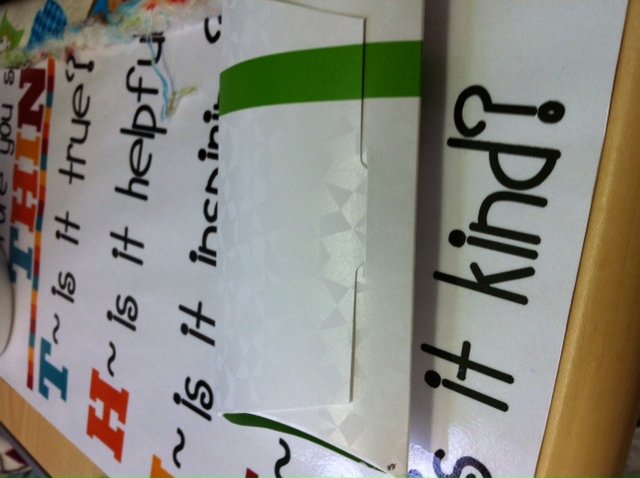
As an avid coffee drinker, I was thrilled and pleased to find this lovely gift. However, what I could not find was the name of the giver of said gift…I had opened the box in this manner.

This seemed to me to be the logical way of opening said box. It had two fold-over flaps on each end and that was how the gift card was delivered to my hand. Feeling frustrated at the secret gift, I pondered sending a blanket thank you to the faculty but then got side tracked…

About an hourish later, my sidekick and I were chatting in the lab and I mentioned that I had received said gift, “but it had no name!”, I decried. He said, “yes it did….” I said, “huh? it’s from you?! Thanks!!” He then proceeded to show me the hidden to/from flap.

“Ah,” I said, “that is clever!” But so interesting that I never would have seen that had he not presented me with the new perspective on how to solve the mystery of the gift card giver.

This has become such a great metaphor for how we view any form of problem or challenge. When we work to collaborative solve problems, we gain new perspectives. When we increase our intellectual capacity by adding extra brains, our solutions come easier. As we approach 21st Century learning experiences, we must be considering the role of collaboration in our teaching and learning. Creating authentic problem solving tasks and helping students build the capacity to collaborate to solve them. For when they gain the experience of viewing new perspectives, oh how they will grow!

(Now it’s time to write my thank you note!)

Exactly!

Yesterday I had the pleasure of doing exactly what I am supposed to do in the job laid out for me. A third grade teacher and I collaborated to have the students produce a project while integrating their social studies and their technology skills acquisition simultaneously. How’s that for a run-on sentence! Their task was to find pictures from an online collection, save them, insert them into Word, and create captions…not brain surgery or web 2.0ish but critical skills and most importantly, connected to their curriculum on Native Americans. In the perfect world, we would have had three days to complete the project. We had 40 minutes that we pushed to 50 by skipping snack. The kids were outstanding. They paid close attention and worked swiftly. They were led through the task one step at a time and then set to their own devises for the second time through to complete the steps again. I marveled at how quickly some of them picked up the steps and counseled those who did not. But all complaints about time aside, this is the kind of collaboration for which we hope. It is my (our) sincere desire to build learning experiences for kids that allow them to put their core content learning into the context of technology rather than working on technology within a vacuum. At the end of the day and a de-brief with the gung-ho teacher, I found myself with a few lingering questions…

How do we articulate the value of basic skills in technology when our digital natives are all about games and fun? Is there still value in working on tasks in Microsoft Office (for example) when these tools may be obsolete by the time these children reach the workforce or even high school? How do we help teachers see that collaboration is necessary for student success AND debunk our assumptions that d.n.’s already know how to use all of these tools?

These questions I leave for another post on another day; I will allow myself a few more hours to bask in the glow of victory in the form of integration bliss.

Overdue Reflections

I am long overdue my reflections from two very different professional development opportunities I experienced in the month of October. My only major excuse is that I got a new dog and have lost all perspective of personal reflection while I make trips to the dog park and enjoy some good snuggles. Please meet Parker, to your left… (I think he is a great excuse not to blog…)

Experience #1: Edscape Conference, New Milford HS

I am so glad that my colleague and I attended this conference run by the coolest school leader since Horace Mann, Eric Sheninger. The best part of the day was the change in keynote. Chris Lehmann had been delayed and was unable to attend so he was replaced by his amazing colleague of TED Talk fame, Diana Laufenberg. She inspired the audience to think beyond technology for technology’s sake and to speak the language of our digital age students by integrating technology into problem-based learning. She encouraged us to build learning experiences for kids where they would be challenged to be critical in their work and learn from mistakes. What an amazing start to the day.

I found myself floating between sessions feeling unsatisfied by what I was hearing from presenters. It wasn’t new, it was stuff that someone with an active PLN should already know. I really wanted this question answered: “how do we move teachers who don’t engage in professional development and struggle with the pedagogical shifts of the 21st century forward in a way that allows us to best serve kids?” Any easy question right? Where is the divide between encouragement/coaching and evaluation/mandate? These questions were not answered on this day but I did have light at the end of the tunnel when this quote was presented in my last session.
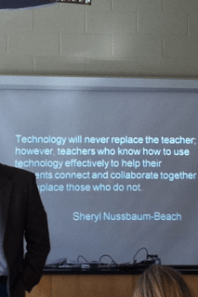
Aha! Yes. This was the reality check that I think I needed to hear (see) someone else say out loud. We are past the point of excuses and must move forward….but again…how?

I’m glad I attended Edscape and connected with a few new PLN folks as well as meeting some of my tweeps in the flesh. My attendance also afforded me the invitation to participate in the Dell Edu Think Tank the following weekend in NYC.

Experience #2: Dell Education Think Tank, NYC

It is not every day you hear my name and the words “Think Tank” in the same sentence. It was an incredible experience to sit among 20 0ther education professionals and the education leaders at Dell  to discuss the shifting paradigms of education. We greeted each other, some known, some unknown, at the headquarters of Scholastic and our conversation, also live-streamed, began. Our moderator, once again the forward-thinking Eric Sheninger, culled our open thoughts and synthesized them into five main topics:

All day, we participated in dialogue, debate, reflection on these five topics, as amazing art was being created to aggregate and illustrate our conversation. As an independent school educator, I found myself intrigued by the contrast of our struggles for implementation as compared to those within public frameworks. For my school, resources are blessedly not a hurdle and we are not bound to standardized curriculum and testing requirements or ridiculous evaluation systems that stifle all creativity. We face a challenge of autonomy. This may not seem a challenge to those who face such great hurdles of resource, access, and curricular lock-down, but it is very real. Autonomy in educational practice is a great gift, but it has the potential for abuse and acceptable complacency.

Which leads me back to my question from Edscape: “how do we move teachers who don’t engage in professional development and struggle with the pedagogical shifts of the 21st century forward in a way that allows us to best serve kids?”  I have drank heartily from the web 2.0 kool-aid. I am an evangelist for balanced use of technology within the curriculum. I am a profound proponent of professional development. But I struggle when the answer to my question is, “Time and Patience”. I have buckets of patience in my ageing years. I don’t have time; neither do you. We cannot miss an entire generation of kids because our fears and comfort levels can’t be challenged.

So while I continue to seek an answer, let us begin small, using technological tools to support global connections in the primary levels. Let us, as the educators, use technology to promote greater communication and collaboration within our own professional practice.  Hopefully time will move slow while we lead the way.

Why We Should Not Hyper-Edit

**Our 4th grade readers have begun blogging. Their blogs are currently only public to themselves and their parents. I look forward to helping them release them to the world at some point. I’m sharing my post from our kid-blog today regarding why we as teachers should not hyper-edit our students.**

As teachers, we always want the very best from our students. We want them to learn and grow as readers and writers (as well as artists, math wizards, athletes, musicians, historians, and citizens) but we also need to create boundaries for them to make their own mistakes and realize them. When we have students blog it is very important for us as teachers to step back from the process at some point. We allow them to form their posts, edit them collaboratively, encourage the use of spell check, promote diverse word choice, and emphasize excellent grammar. However, there are times when our instruction may not be heeded and it is very important in that moment to allow the child to make the choice to publish or save as draft. If they publish a minor mistake or we don’t love every aspect of their content, we must refrain from editing their work. Their blogs are their own. They must take ownership of their work and we, confidently knowing we have done all we can to help shape their work, must allow them to take this ownership. This is not always the easiest task, to let our birds fly from the nest and occasionally make mistakes, but we will be better teachers, and they, better students for allowing them to do so.