10 Nerdy Teacher Books

(**This is a cross post with my personal blog in which I am sharing 10 books a day for a week.** Today’s topic was Nerdy Teacher books so I thought a cross-post was worthy! Enjoy!**)

It is time for Day Two of 10 Books a Day! Today’s topic. Nerdy Teacher Books. Being a teacher is not just my job, it is my calling. As a child, if you came to my house, we played school. I have had teachers over the years who have inspired me and those who have challenged me. I hope I am a little bit of both. One thing I know for sure is that I model life-long learning for my kids. I’m always carrying around some kind of book that guides me as a teacher or teacher-leader. I have a MILLION books (some from ed school, some picked up along the way) but here is a small sampling of my favorites.

  1. The Call of Stories by Robert Coles. A collection of stories that encourage us to to listen to others and to continually self-reflect. We read one of the stories in our work at the Klingenstein Summer Institute 2008.
  2. A Whole New Mind by Daniel Pink. The right-brainers have been in the corner long enough. In his seminal work, Daniel Pink argues that right-brained thinkers will shape the future and we must nurture empathy and creativity for success. Good discussion guide for you and your colleagues.
  3. Curriculum 21 ed. Heidi Hayes Jacobs. I may quite possible be obsessed with this book right now. I haven’t even finished it yet (it is my summer reading of choice) and I’m overwhelmed by the brillance of it. It is my new manifesto. A call to “arms” for a complete re-think of how we do school in 2012 and beyond. I recommend it for anyone who is tired of “old skool” and encourage school leaders to share it with their staffs. Start a Revolution!
  4. Why Don’t Students Like School by Daniel Willingham. An interesting, cognitive-science based look at why students don’t engage in school. This is just one perspective that is jam-packed with scientific analysis. It is a heavy read and not something I would call “inspiring” but for your teacher who wants data, this is it.
  5. The Unschooled Mind by Howard Gardner (all books by HG) There is no argument that the work of Howard Gardner has shaped educational theory for the last several decades. His work in multiple-intelligence theory is so incredibly useful (even if it is oft refuted). The Unschooled Mind is just one example of his thought-provoking work. We must teach children to understand and learn with depth rather than just regurgitate. (I shouldn’t even get started on this topic!)
  6. Leadership on the Line by Heifetz and Linsky. Not an education book per say, but my favorite book from my master’s program in school leadership. Personal (sometimes a bit too much, Marty Linsky in the bath tub, ew!) and thoughtful, it allows the reader to create mental models of what leadership can look like when you get “on the balcony” and get the whole picture. Highly recommended for leaders facing a crisis or those who want pre-emptive strategies.
  7. Other People’s Children by Lisa Delpit. How do our assumptions and stereotypes impact our work in the classroom? How does our educational policy structure perpetuate low achievement and discrimination? Dr. Delpit explores it all in her best work. She explores the stories of teachers and the negative impact they can have when working with students of color.
  8. Odd Girl Out by Rachel Simmons. Like Queen Bees and Wannabes orReviving Ophelia, Rachel Simmons explores Girl World and the aggressive culture that exists, particularly in adolescence that can be terribly crippling. The word “bullying” has become a catch-all term for some developmental skirmishes children encounter but true bullying can leave lasting scars and it cannot be accepted, ever.
  9. The Students are Watching by the Sizers. We are not merely responsible for the 3 R’s anymore. We are integral parts in the moral development of children. Anyone who doesn’t think this should walk away from the classroom, right now. We shape character more than we teach math, English, music, or history. This is truly the purpose of school.
  10. Understanding by Design by Wiggins and McTighe. UbD has exploded since its inception as a major framework of teaching and learning. I don’t follow all of the pieces of the framework and have not used it regularly but I concur with one major point. We must know “where we are going” in order to get there. We must plan with the end in mind and we must engage the children in this process so THEY know where they are going and WHY.

I could go on and on and on…..particularly if I created sub-categories and such but for now…I shall stop. Happy Reading.


Three Words Wednesday

I’m at The Connections Conference at Sidwell Friends School. Today I’m exploring the educational use of iPads under the direction of Melissa Scott. we are following the model of DS106.

We each have tasks for the next hour to work on a project. I chose a Writing Assignment (duh) which I’m going to morph a bit. I chose Three Word Wednesday.

Here is my project: THREE WORD WEDNESDAY WRITING

Here are my words for the day:

Fog; noun: A thick cloud of tiny water droplets suspended in the atmosphere at or near the earth’s surface that obscures or restricts visibility; an opaque mass of something in the atmosphere; something that obscures and confuses a situation or someone’s thought processes; verb: Cover or become covered with steam; bewilder or puzzle (someone).

Lenient; adjective: (Of punishment or a person in authority) permissive, merciful, or tolerant.

Struggle; verb: Make forceful or violent efforts to get free of restraint or constriction; strive to achieve or attain something in the face of difficulty or resistance; engage in conflict; make one’s way with difficulty; noun: A forceful or violent effort to get free of restraint or resist attack; a determined effort under difficulties; a very difficult task.

While I respect the traditional definitions of all of these words. I wanted to find a common theme for all three words and I found it locally in the space that I am in; Middle School.

20120620-142039.jpg

In middle school our children (and we at their age) find themselves in the constant cognitive fog. They find themselves desperately seeking autonomy and limits simultaneously. They seek action and serenity. They seek freedom to make mistakes and leniency when they have failed.

Middle School is a constant struggle between finding your identity and joining the crowd. It is a time where right and wrong are often blurred beyond recognition. Where the frenetic pace of life goes completely against the needs for calm and structure.

So the synthesis of my three words, fog, lenient, and struggle fit directly into the common theme of that great messy space called Middle School.

20120620-142618.jpg

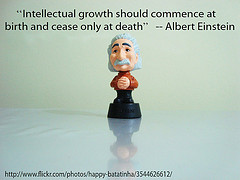
Albert’s View of Learning

Albert

Originally uploaded by DaGlinch

That Albert knew a thing or two. As we all head into our summer recesses be they full vacations or short spurts of respite, may we constantly model our intellectual growth and professional development. For our students, our own children, our colleagues, and the world at large. Let us be the model examples of life-long learning for those around us and let us use the tools at our disposal to share our learning and participate in the global conversation.

Change is always with us. Let us embrace the change of learning with a committed heart and an open mind.

Open Education Resources

The concept of Open Education Resources came to the forefront of my attention yesterday. As defined by Wikipedia, OER  are “digital materials that can be re-used for teaching, learning, research and more, made available free through open licenses, which allow uses of the materials that would not be easily permitted undercopyright alone.” Essentially these are resources that allow users to find content and materials for their defined objectives, they are typically free and not subject to strict copyright laws. While these resources are plentiful for higher education, the burgeoning field of resources for K-12 is about to explode.

Here is the article that added to my sparked inquiry today from KQED/MINDSHIFT.

Here are just a few resources found through a quick search:

OER COMMONS

  • database of resources that can be searched via grade level and content area.

Creative Commons and OER

101 OER Resources

  • a slideshare with a ridiculous amount of resource options

Open Education Resources

  • from JISC in the UK

I could go ON and ON about this topic and discuss Khan Academy, HippoCampus, CK-12, YouTubeEd, iTunesU or a host of other sites but it comes down to this… OER are a form of empowerment. By having open resources at the click of a mouse, we as teachers can be empowered to find our own resources, share our creations, and find the best fit for our individual students without having to purchase out-dated, expensive textbooks or buy pre-set materials. We must take advantage of this gift to glean resources that suit OUR kids and open the door for them to navigate their own learning process.

I’m planning to model this in my own practice by brushing up on my math skills. I am terrible at math. Yes, I admit it to the whole wide web world. Anyone who knows me professionally or personally knows that I am extremely math-phobic. A friend said today, “why don’t you take a course to catch up on your skills?” AHA! I can use OER to do this. I have created my own textbook using CK-12, made an updated account on Khan, and am going to download podcast/videocast options from iTunesU. This will allow me, the life-long learner, to remove the excuses of “I can’t learn that” from my vocabulary in direct practice.

Empowerment!

SOURCE

Happy Teacher Appreciation Day!

She was a formidable woman. When I first entered her classroom her presence alone commanded respect. It was expected. She sat down on her desk next to her trusty overhead projector, vis-a-vis pens at the ready. Over the course of two years, we would outline the history of Europe and the United States with detail and efficiency. The note taking lessons were valuable for the rest of our lives, but it was the effusive love of history that engaged us. Her notes were concise but her stories were deep and wide. She made the past come alive with her stories.

More than that…she saw the best in each of us. She saw a girl with low self-esteem, poor study habits, and an elementary education that had not prepared her for the rigors of private school and looked beyond. She took that girl in with love, empathy and taught her how to learn, how to organize, and how to become passionate about her students. She looked beyond the numbers in the grade book and encouraged the individual gifts. She held her students to the highest expectation possible and did not take mediocrity as acceptable. She believed in us. She loved us.

And we loved her back. She inspired a generation of people to work hard and give to others. The girl with low self-esteem and a tumultuous life in middle school grew to be a teacher, hoping dearly to emulate her love and care for students in every way. And she is grateful.

Thank you Mrs. Sobel. You made a difference.

http://hyperakt.com/work-detail/293

Now.

“There can no longer be an “opt out” clause when dealing with technology in our schools, especially from our administrators. We need to prepare our kids to live in this world now and in the future. Change may feel hard, but it is part of learning. We expect it from our kids, we need to expect it from ourselves.” — George Couros

I was reading through my fb feed this morning and this blog post came through from The Principal of Change, George Couros. Quick summary, the post tagged just above is an aggregate of all of his posts regarding social media use by admin and teachers. More than that, it is a manifesto of sorts for the need for fundamental changes in our teaching and learning.

I spent the weekend at the AIMS Technology Retreat and enjoyed listening to the work of Mike Muir of mcmel and the ever progressive Gary Stager. I enjoyed conversations with technology and library colleagues from across the DC metro area. The message was clear, it is time to change. There were lots of fancy power points and videos about the change process, planning for change, and resources for integrating technology into the curriculum. But the core message was missing…our kids need this now. There is no longer a place for the, “I won’t do that”. Our students deserve our best modeling of life-long learning. In order to model life-long learning you have to actually….be a learner.

I present you this call to arms my friends and colleagues, we must rise up to raise the bar of expectation for our teaching and learning. It is not about technology;  it is about a re-think of how and what school should be in the 21st century. Sure, we could wait five years for a complete cycle of change where everyone feels warm and fuzzy and comfortable but in that time period, an entire set of elementary children will have gone to middle school with our “old ways”. This is simply not fair for these children. Please join me in the conversation and the movement to change our classrooms by first changing ourselves.

@Teach2Connect

Creating a Consistent Persona

When I started to blog and tweet professionally about 4 years ago, I didn’t realize how creating a persona (read: branding) would blow up all over the place. What started as a public reflection space for me has turned into friends with domains, colleagues blogging and tweeting, new connections from around the globe, etc. It has made me really think about the separation of personal and professional. My tweets are generally professional with a smattering of food and sports thrown in but my facebook page has always been a strong mixture of both. My blogs are separate. My personal blog is about running, food, God, and personal growth. This blog is about teaching, philosophy, change, and leadership. I want to write for two separate audiences.

This week I had a great conversation with colleagues at the AIMS Technology Retreat. We discussed the way we separate personal and professional within our social media platforms. It really got me thinking about each of my portals and how I have set boundaries of professional and personal. I decided it was time to add another layer of boundary in my social media persona. So I have created a Teach2Connect facebook page. This way I can share with my PLN while at the same time not boring my non-school family and friends with thoughts, articles, and tweets about school. (I can also spare my PLN from ramblings about food, my dog,  running, and my excessive television habits.)

Our students don’t understand these boundaries yet and perhaps never will. I don’t suggest this kind of Berlin Wall for their own social media use as I think our trends are changing. Since my target audience for my blog, tweets, and now fb page is generally above the age of 28, I thought it would be appropriate to create the boundaries with which we are comfortable.

What does that mean? If you are in my PLN or I am in yours (hopefully both), pop on over to Teach2Connect’s facebook page. If we are friends on fb and you want to dump me on my personal page, no offense will be taken! Either way, I hope we remain vigilant in the conversation of re-thinking teaching and learning, reinventing school leadership, and revoking antiquated ways to learn.

States Anyone?

Our third graders are beginning their final social studies project of the year. A project on the states. Some are doing papers, some post cards, some creating books, some making comparative studies with yesteryear and today, but all will be studying the states in some way, so I thought I would share the wiki page of resources with you to share with your students!

While I won’t argue the validity of memorizing state capitals in this space today, I will say that finding the Animaniacs video of Wakko’s State Capitals was a great throw back to my school days.

General Search Resources 

  • This links to our research page to help you find search engines like BoolifyKidRexDuckDuckGO, and Sweet Search that help you search safely without using regular google.

http://www.kids.gov/k_5/k_5_states.shtml

  • This is a government authored site that links to each individual state’s kid page. These resources vary by state.

http://www.enchantedlearning.com/usa/states/

http://www.census.gov/schools/facts/

  • information about kids found via the US census

http://bensguide.gpo.gov/3-5/state/index.html

  • Short fact pages for each state provided by the Government Printing Office

http://50states.mrdonn.org/

  • Mr. Donn’s pages are excellent and link out to many good resources. You will have to “dig” a little but it is worth it.

http://www.socialstudiesforkids.com/subjects/usstatescolonies.htm

  • Social Studies for Kids provides succinct articles about many states. (Please note they do not currently have every state.)

http://www.shgresources.com/resources/almanac/

  • This site provides almanac pages for each individual state. They are written by the State Handbook guide, a commercial site.

MEMORIZE YOUR STATES AND CAPITALS

States and Capitals Games from Sheppard Software

  • This page of games has many options and levels to practice states and capitals!

States and Capitals Penguin Game

  • Move your penguin to match states and capitals.

Sporcle’s State Capitals Game

  • Sporcle has no-nonsense quizzes galore. Not flashy or exciting but will help you test your knowledge of state capitals.

KidsPost State Match

  • This game from The Washington Post’s Kids Post has you match the state with common facts and figures.

Line Match Game 

  • Match the states and their corresponding capitals with a line graph. It shows five states at a time.

Parker’s lessons on empathy.

Five months ago the lives in our house changed forever when we adopted a rescued lab-pit mix named Parker. We had been stalking him on facebook for a while and finally decided that he had to live with us. It has been a challenge and blessing. We love his cuddles and his windmill wagging tail. We love taking him to the trails near our home and letting him run in the woods with us. We are challenged by his pulling on leash, his anxiety-aggression with people in our home or on walks, and various other unsavory behaviors. We have recently begun training and have to clarify our human-adult roles so that we can be a strong functional family. We, the parents, need to work on our concrete communication with him. He has already begun to learn new behaviors in just a few short sessions.


What in the world does this have to do with teaching and learning?? A LOT!

Parker has taught me a lot about empathy. Specifically, empathy for kids and parents who struggle with emotional or learning differences. I know I was an obstinate, frustrating, smart, and sometimes bored student in my early years. I provided my parents, my teachers, and my administrators with more challenge than was acceptable and took more than my fair share of time in a class of 28 students. I can’t even imagine what it must have been like to be my mom, sitting in many a parent-teacher conference, hearing once again about my behavior in class, my inability to sit still, my incomplete work, my outbursts for attention. What exasperation and, dare I say, embarrassment I must have caused her in my early years.

This leads me to think of the parents of “that kid”. When I say “that kid”, I do not mean it from a derogatory perspective and I see my own child-self in this category. The child who’s needs are not always easily met or understood. The child who struggles in a visible way with social-emotional or academic needs in school (or home).  The child who repeatedly takes up unequal amounts of time within faculty meetings. You know this kid too and probably stay awake at night, as I do, trying to solve the mystery that is child X. I have watched the parents of these children from an entirely new perspective in the last few months. How they must struggle with wanting to find solution and healing for the children and yet also feel a sense of helplessness or frustration? I wonder if perhaps they feel a sense of failure or have a desire to place blame on themselves or others. This is purely projection on my part, as I feel helpless when Parker misbehaves at the park or doesn’t come when called. And I realize it may be offensive to some for me to make a corollary between a dog and a child, the emotions are both so very real.

So I grow in my empathy and my desire to seek understanding with parents as I, in a sense, become a parent of a challenging “child”. I am so grateful for this lesson as it has deepened my commitment to growing relationships with families to truly be a support for all children. We all have a bit of “that kid” within us and we must grow to celebrate these differences and empathize with their repercussions rather than place shame or blame.

Thanks for the lesson, Parker. Now sit….stay….good boy.